
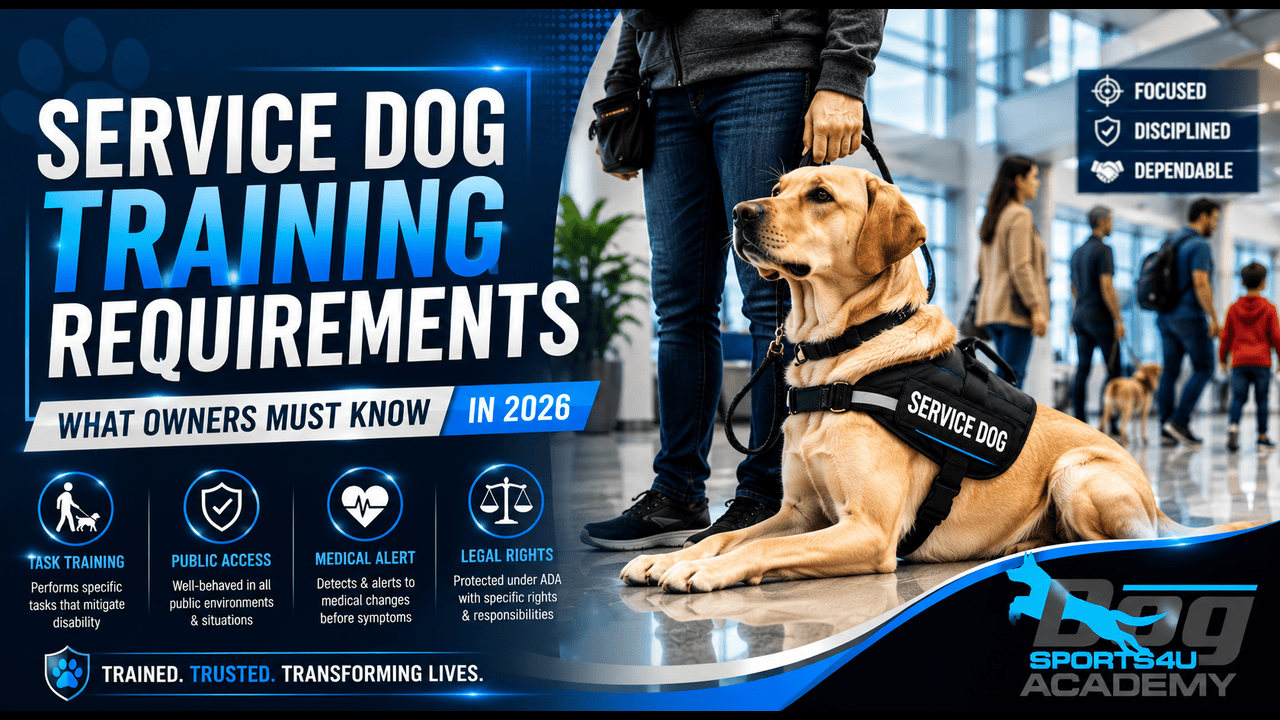
Service Dog Training Requirements: What Owners Must Know in 2026
Jun 16, 2026Most people see a dog in a vest and assume the designation is automatic. It is not. The gap between a beloved pet and a legally recognized service animal is not a registration website or a purchased certificate.
It is hundreds of hours of precise, layered training that most dogs will never complete, and that most handlers underestimate until they are standing in a public space watching their dog lose composure under distraction.
That gap has real consequences. Understanding what service dog training genuinely requires protects your rights, your dog, and every handler who depends on legitimate access protections daily.
The Dog Who Cannot Be Faked Out
Why Temperament Outranks Everything Else
German Shepherds and Labrador Retrievers have dominated service dog programs for decades, and the reasons run deeper than familiarity. Labs carry food motivation and emotional steadiness under pressure that makes complex task training efficient and repeatable across months of structured work.
German Shepherds form handler bonds of unusual depth, which suit psychiatric service work and mobility assistance equally well. Golden Retrievers read human emotional states with a sensitivity that positions them as standout candidates for seizure alert and medical response roles.
That said, Standard Poodles have earned serious recognition in service work, particularly for handlers with allergies. Their intelligence places them in the top tier of working breeds, and their capacity for attunement is consistently underestimated by people who associate them exclusively with show rings.
What Actually Determines Suitability
Breed is a starting point, not a guarantee. Temperament evaluation from the earliest weeks is what determines whether a dog has the composure that public access work actually demands.
What ADA Service Dog Requirements Mean on the Ground
Task Training Is the Legal Line
Under the Americans with Disabilities Act, a service dog must perform a specifically trained task that directly mitigates the handler's documented disability. Comfort through presence alone does not meet that standard legally.
A dog trained to detect blood sugar shifts and alert before symptoms escalate, interrupt dissociative episodes, retrieve dropped items for a mobility-impaired handler, or apply deep pressure during a PTSD response absolutely qualifies. These are trained behaviors, not personality traits.
Beyond that, Florida handlers across Sarasota and the Gulf Coast occasionally encounter businesses unfamiliar with the two legally permitted ADA questions. A dog with disciplined public behavior and a handler who knows their rights resolves those situations before they escalate.
What Service Dog Certification Is and Is Not
Service dog certification from private organizations is not required by federal law. What matters is reliable task performance and appropriate behavior in every environment the handler enters.
The Training Sequence That Cannot Be Compressed
Foundation Before Function, Every Time
Service dog training operates across multiple disciplines simultaneously, and no phase can be skipped. Precision obedience must be deeply established before task work begins.
A dog who cannot hold a reliable down-stay through a noisy hospital corridor cannot alert to a medical event in that same environment with any consistency. This is not a theoretical concern. It shows up in real public access situations every time.
Public access conditioning runs alongside task development throughout the entire process. This means structured exposure to shopping centers, transit environments, crowded public spaces, and the unpredictable behavior of strangers, children, and other dogs.
That neutrality is trained behavior, not temperament alone. It requires consistent reinforcement across dozens of real locations over many months before it becomes genuinely reliable.
How Long the Process Actually Takes
Task training for medical alert, psychiatric support, or mobility assistance begins after obedience and public access foundations are genuinely solid. Total development from a puppy starting at eight weeks to a reliable, independent service dog runs between eighteen months and three years.
Anyone suggesting a significantly shorter timeline is either working with an experienced adult dog or skipping phases that will cost the team later.
The Handler Is Half the Team
Your Training Matters as Much as the Dog's
Even the most precisely trained service dog will lose reliability in the hands of a handler who was not educated alongside their animal. Handlers must understand reinforcement timing and how to maintain task behaviors during high-stress episodes.
They also need to read their dog's stress signals before those signals become public problems, and to advocate confidently for their legal access rights. Without that owner preparation, the training investment depreciates rapidly.
Where Expertise and Dedication Meet
Service dog training near me is a search that deserves a careful answer. DogSports4U Academy brings decades of elite expertise to service dog clients across Sarasota, Venice, and Southwest Florida, with programs built entirely around each handler's specific needs and each dog's individual strengths.
Don't miss a beat!
New tips, motivation, and classes delivered to your inbox.
We hate SPAM. We will never sell your information, for any reason.
