
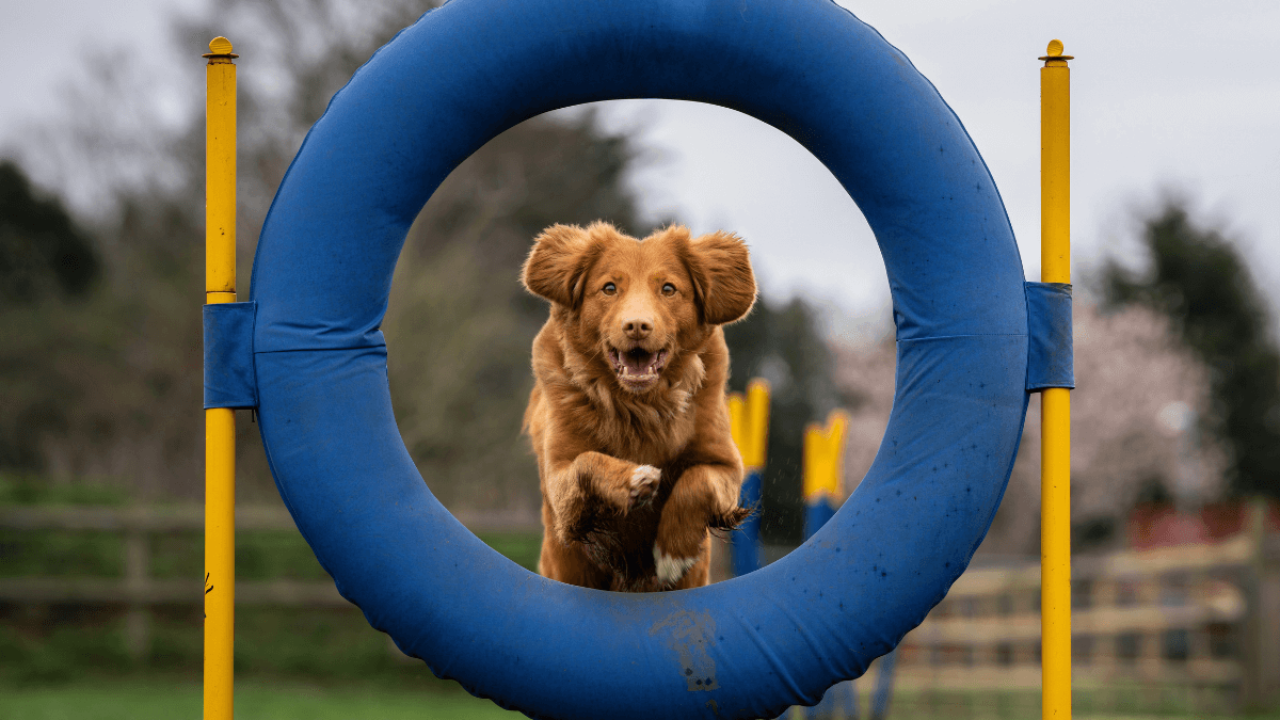
What Skills Do Dogs Learn in Agility Training in Sarasota?
Apr 19, 2026Watch a Border Collie weave through a twelve-pole sequence at full speed without breaking stride, or a Papillon launch over a double bar jump and land in perfect collection before driving into the tunnel, and you understand immediately that dog agility training in Sarasota, FL, is not a hobby.
It is a precision sport built on the accumulated foundation of hundreds of training hours, a fluent communication system between dog and handler, and a dog whose body mechanics, confidence, and drive have been developed with genuine intentionality.
What looks effortless in the ring is the result of methodical skill-building that begins long before a dog ever approaches an obstacle.
What Is Agility Training for Dogs, Really?
Agility is a competitive canine sport in which a handler directs a dog through a timed obstacle course that includes jumps, tunnels, contact obstacles such as the A-frame and dog walk, weave poles, and pause tables.
The dog runs off-leash, guided entirely by the handler's body position, verbal cues, and movement. Scoring is based on both speed and accuracy, with faults assigned for refusals, knocked bars, and contact zone violations.
At the highest levels of competition, the margin between placements is measured in fractions of a second. That precision comes directly from the quality of training both dog and handler have invested in.
Beyond competition, agility is one of the most effective enrichment activities for high-drive, high-energy breeds.
An Australian Shepherd who has been doing agility work three days a week is a different dog to live with than one whose physical and mental energy has no productive outlet. The structured problem-solving, the handler communication, and the physical demands of the sport address the whole dog in a way that daily walks simply cannot replicate.
The Foundational Skills Built Before Any Obstacle Is Introduced
In professional agility development, a dog never approaches an obstacle before foundational body awareness and handler communication are established.
Proprioceptive conditioning, which involves exercises like cavaletti poles, balance discs, and lateral movement drills, teaches the dog where its body is in space.
This is particularly critical for large breeds like Standard Poodles and Golden Retrievers, whose natural body awareness is lower than that of a compact, agile breed like a Shetland Sheepdog.
A dog that cannot collect its stride and regulate its momentum cannot safely navigate contact obstacles or jump sequences.
Agility Classes for Dogs in Sarasota: What to Expect at Each Level
Foundational agility classes begin with target training, restrained recalls, and flat obstacle introductions at minimal height. The tunnel is typically the first full obstacle introduced because it has the lowest physical risk and the highest intrinsic reward for most dogs.
Jump heights begin well below competition standard, building confidence and correct jumping mechanics before any intensity is added.
Weave poles, which are often the last skill to be fully trained, are introduced through channel methods or guide wires that shape correct entry and footwork gradually, because rushing the weave sequence produces errors that are exceptionally difficult to correct once they become habitual.
Intermediate classes introduce sequencing, which is the ability to perform multiple obstacles in order while maintaining speed and confidence.
Handler skills, including front crosses, blind crosses, and rear crosses, are taught at this level because the dog's performance is always contingent on the clarity of the handler's directional communication.
A dog that slows before the weave poles is often responding to a handler who is inadvertently decelerating in that zone, not to a gap in the dog's own training.
Agility Training for Dogs in Sarasota County: Breed Considerations
Border Collies, Australian Shepherds, and Shelties are considered the elite competitors in the sport for reasons rooted in their herding heritage.
They read human movement with extraordinary sensitivity, maintain drive across long sequences, and have the physical athleticism to match their mental sharpness. But they are not the only breeds that excel.
Whippets and Greyhounds bring raw speed and athletic grace to the jumpers' courses.
Jack Russell Terriers are among the most competitive dogs in their height category, combining drive, flexibility, and handler focus in a compact package.
Even breeds not typically associated with the sport, like Cocker Spaniels and Welsh Corgis, reach impressive competitive levels with the right foundation training.
When the Course Becomes a Conversation
The highest expression of agility is the moment when handler and dog move through a course as a single communicative unit, with neither leading nor following but responding to each other in real time.
Building that relationship requires trainers who understand the sport's technical demands, the individual dog's drive profile, and the handler's physical communication patterns.
At DogSports4U, agility development is built into a comprehensive training philosophy that recognizes the sport as an extension of the bond rather than a separate discipline imposed upon the dog.
FAQs
Don't miss a beat!
New tips, motivation, and classes delivered to your inbox.
We hate SPAM. We will never sell your information, for any reason.
