
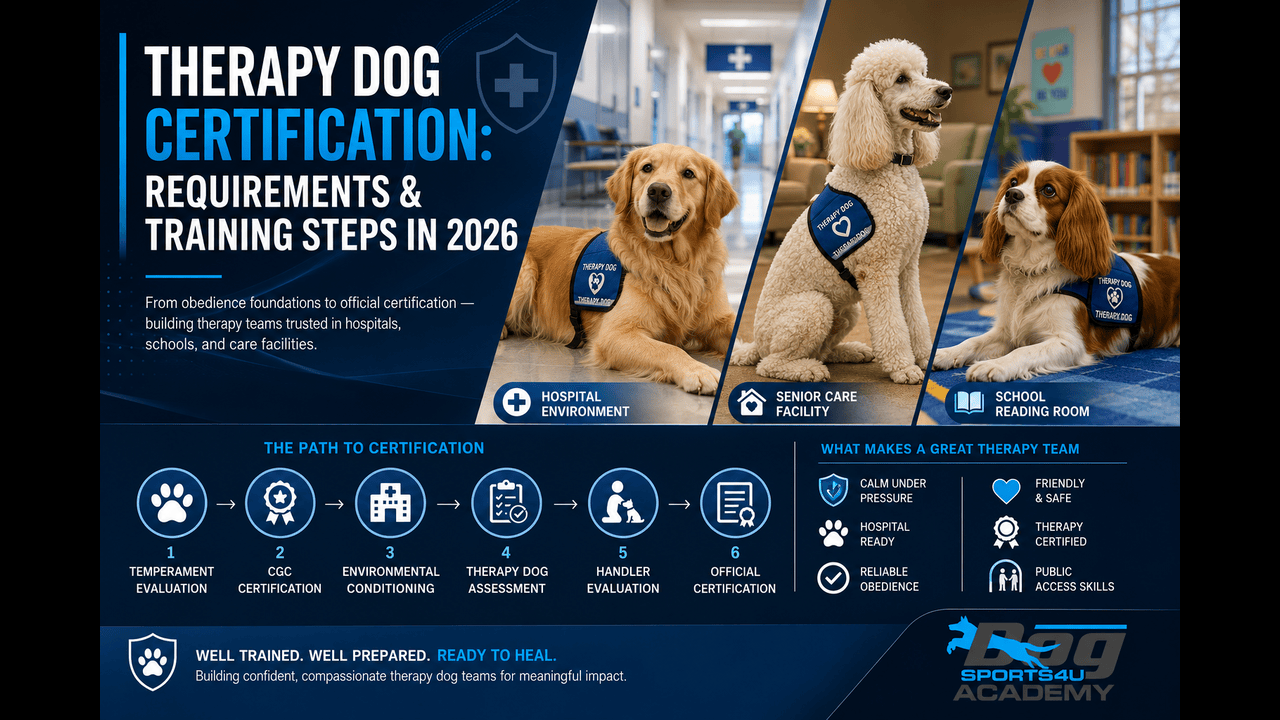
Therapy Dog Certification: Requirements and Training Steps in 2026
Jun 25, 2026There is a Golden Retriever at a children's hospital in Sarasota who has sat beside more frightened kids than most pediatric nurses can count. She does not flinch at IV poles, hospital smells, or small hands grabbing her ears without warning.
She is not naturally perfect. She was trained, evaluated, and certified through a process that took her owner the better part of a year to complete correctly.
That process is what separates a dog who is friendly from a dog who is genuinely safe to place in environments where vulnerable people depend entirely on the animal's stability.
Therapy Work Is Not What Most People Imagine
The Environment Demands More Than a Good Temperament
Therapy dogs visit hospitals, rehabilitation centers, assisted living facilities, schools, and crisis counseling environments. What they encounter inside those spaces bears no resemblance to a quiet living room.
Wheelchairs, walkers, loud overhead announcements, the smell of antiseptic, and strangers approaching from every direction without warning are all part of a standard working day. A dog who loves people in calm, familiar settings is not automatically suited for this.
Therapy dog requirements go considerably beyond a friendly personality. The dog must demonstrate that his composure holds under stress, that he accepts unexpected handling without reacting, and that environmental novelty does not produce fear responses.
Why Temperament Testing Comes First
Every recognized therapy dog organization requires a formal temperament evaluation before any placement. That evaluation exists because the consequences of an unsuitable dog in a clinical environment affect some of the most vulnerable people in that facility.
Breeds That Excel and What Makes Them Stand Out
Natural Aptitude Still Requires Deliberate Development
Golden Retrievers remain the most widely deployed therapy dogs in institutional settings, and their prevalence is earned. Their tolerance for handling, their attunement to human emotional states, and their ability to stay regulated under sensory pressure give them a natural advantage.
That said, natural aptitude without structured preparation produces inconsistent results. Even the most temperamentally suited Golden needs systematic exposure to clinical environments before being asked to work inside them.
Standard Poodles carry intelligence, physical adaptability, and a genuine sensitivity to human emotion that makes them deeply effective therapy animals, particularly in settings serving adults. Their low-shedding coats also make them practical choices for facilities with allergy policies.
Cavalier King Charles Spaniels bring a gentleness and body softness that suits settings working with children, elderly residents, and people in emotional distress. Their smaller size makes them highly manageable in confined clinical spaces.
How to Certify a Therapy Dog in 2026
The Steps That Cannot Be Skipped
Therapy dog training begins with a foundation of reliable obedience. The American Kennel Club Canine Good Citizen evaluation is the minimum behavioral standard that most major therapy dog organizations accept. Passing the CGC demonstrates that a dog can heel on a loose leash, sit and stay reliably, accept handling from strangers, and remain calm around other dogs.
These are starting-point requirements, not completion criteria. After CGC completion, therapy dog candidates need controlled exposure to the specific environments they will enter before any official evaluation.
The dog's responses during those visits reveal whether further desensitization is needed or whether the team is genuinely ready for certification. Skipping this stage produces teams that pass their evaluation and struggle in the first week on the floor.
The Handler Evaluation Nobody Talks About
Most recognized organizations, including Alliance of Therapy Dogs and Pet Partners, require a handler test alongside the canine evaluation. Handlers must demonstrate that they understand how to manage their dog's stress in working environments.
They also need to know how to advocate for the team when a particular situation exceeds the dog's capacity on a given day. That judgment call is a skill that develops through training, not instinct alone.
What Makes a Therapy Team Truly Reliable
Preparation That Goes Beyond the Minimum Standard
The best therapy teams are not simply the dogs who passed their evaluations. They are the dogs whose handlers trained with enough depth to anticipate stress before it becomes visible.
They know when to shorten a visit, when a particular room is not the right fit that day, and how to decompress the dog appropriately after an emotionally demanding session. That level of handler awareness is what sustains a therapy team over years of work rather than months.
Where That Standard Gets Built
DogSports4U Academy prepares therapy dog teams across Sarasota and the Gulf Coast with programs that address obedience foundations, environmental conditioning, and handler preparation as a unified process rather than separate checkboxes.
Don't miss a beat!
New tips, motivation, and classes delivered to your inbox.
We hate SPAM. We will never sell your information, for any reason.
