
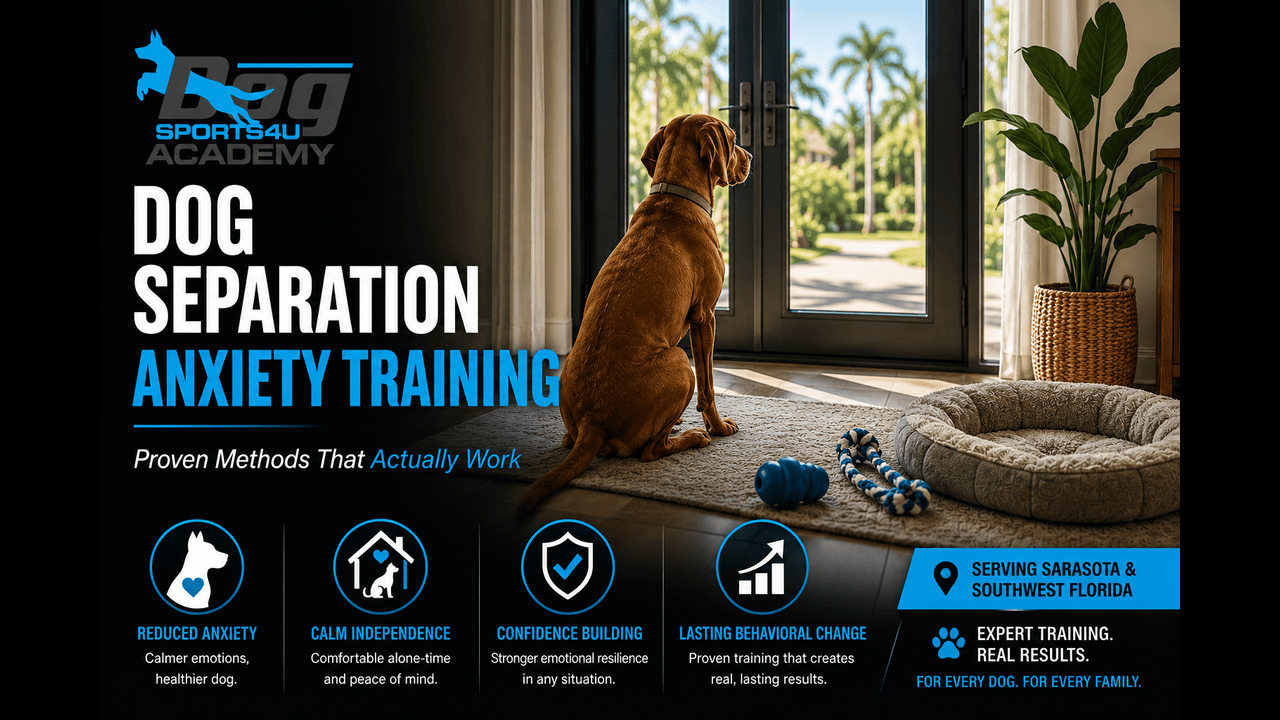
Dog Separation Anxiety Training: Proven Methods That Actually Work
Jun 30, 2026You know what it sounds like before you even reach the elevator. The whimpering starts the moment you pick up your keys. By the time you reach the parking lot, your Vizsla has already worked himself into a physiological stress response that will sustain for hours.
You come home to destruction you did not choose to cause, to a dog whose nervous system has been running hot all day, and to guilt that accumulates with every single workday.
Separation anxiety in dogs is one of the most misunderstood behavioral conditions in companion animal care, and one of the most treatable when addressed through the right framework.
What Separation Anxiety Actually Is and Is Not
Boredom and Anxiety Are Not the Same Problem
A Labradoodle who chews a couch cushion while his owner is at work may be anxious, or he may simply be under-exercised and under-stimulated. These are meaningfully different problems that require different solutions.
True separation anxiety in dogs produces a stress response tied specifically to the owner's absence, not to the dog's activity level or enrichment status. Increasing exercise can help a bored dog significantly. It does not resolve genuine anxiety.
True separation anxiety involves real physiological arousal, not just behavioral inconvenience. Heart rate elevates. Cortisol climbs. The dog is not choosing any meaningful sense of that word. He is in distress, and the distinction changes everything about how the problem must be addressed.
The Breeds That Carry the Highest Risk
Handler-Bonded Dogs Feel Absence Differently
Vizslas are sometimes called Velcro dogs, and the description is accurate. They form handler attachments of unusual intensity and feel absence in a way that physically affects their behavior and physiology.
A Vizsla who has not been systematically taught to tolerate independence from puppyhood is at significant risk of developing severe separation distress the first time his schedule changes. That risk is manageable with early, deliberate training.
Border Collies carry anxiety risk through a different pathway. Their high sensitivity and processing speed mean that schedule disruption and handler absence register with an intensity that more stoic breeds do not experience.
Cocker Spaniels are among the most frequently diagnosed breeds for separation-related distress, with a combination of social dependency and emotional sensitivity that makes structured independence training essential from early on. Labradoodles, popular across Florida families for their temperament, inherit anxiety predispositions from both contributing breeds and benefit enormously from early structured alone-time training.
How to Help a Dog With Separation Anxiety
The Protocol That Changes the Emotional Response
Dog anxiety training for genuine separation distress operates through systematic desensitization. The goal is not to teach the dog to tolerate departure. It is to change the emotional experience of departure entirely, so that the owner leaving no longer predicts something frightening.
The process begins at the dog's current threshold, which in severe cases means the owner moving toward the door without the dog showing any stress signals. From that starting point, departures are extended in tiny, carefully managed increments over days and weeks.
The dog never experiences distress during the protocol because the protocol never exceeds what the dog can handle at that specific moment. This is painstaking work. It cannot be rushed without resetting progress already made.
Why Skipping Stages Costs More Time Overall
Owners who attempt to skip stages because the dog seemed fine yesterday and push too far today will find that setbacks in desensitization take longer to recover from than the original baseline did. Patience here is not passive. It is the active mechanism through which lasting change is produced.
What Owners Are Getting Wrong
The Management Mistakes That Deepen the Problem
Returning to a distressed dog and immediately offering comfort teaches the dog that distress produces reunion. That association reinforces the very emotional pattern the training needs to dismantle.
Punishing anxious behavior teaches the dog that departure predicts punishment in addition to isolation. Acquiring a second dog to provide companionship occasionally resolves mild cases and frequently adds a second anxious dog to the household.
None of these are solutions. Effective management during the training period means preventing full anxiety episodes from occurring while the desensitization protocol builds the dog's genuine tolerance at a pace the nervous system can actually absorb.
When the Dog You Love Deserves Genuine Relief
Separation anxiety near Sarasota requires expertise that goes beyond standard behavioral advice. DogSports4U Academy works with owners and dogs across Southwest Florida to address separation distress through proven, science-grounded methods that produce real, lasting behavioral change.
Don't miss a beat!
New tips, motivation, and classes delivered to your inbox.
We hate SPAM. We will never sell your information, for any reason.
