
IGP Dog Training: What Is It and How to Get Started in 2026
Jun 27, 2026Most people outside the working dog community have never heard of IGP. Those inside it rarely talk about anything else. It is a sport that reveals, with absolute precision, the quality of the relationship between a handler and a dog.
There is nowhere to hide in a trial setting when your Belgian Malinois has to track a stranger's scent across a field, execute off-leash obedience with precision, and demonstrate controlled courage in a protection phase, all in a single afternoon.
What that looks like from the outside is impressive. What it takes to get there is a level of commitment that changes how an owner understands dogs entirely.
What IGP Actually Tests
Three Disciplines, One Complete Picture
IGP, formerly known as Schutzhund, is an international dog sport rooted in the German working dog tradition. It was originally developed as a breed suitability test for the German Shepherd to ensure that breeding stock carried the drives, stability, and trainability required for working roles.
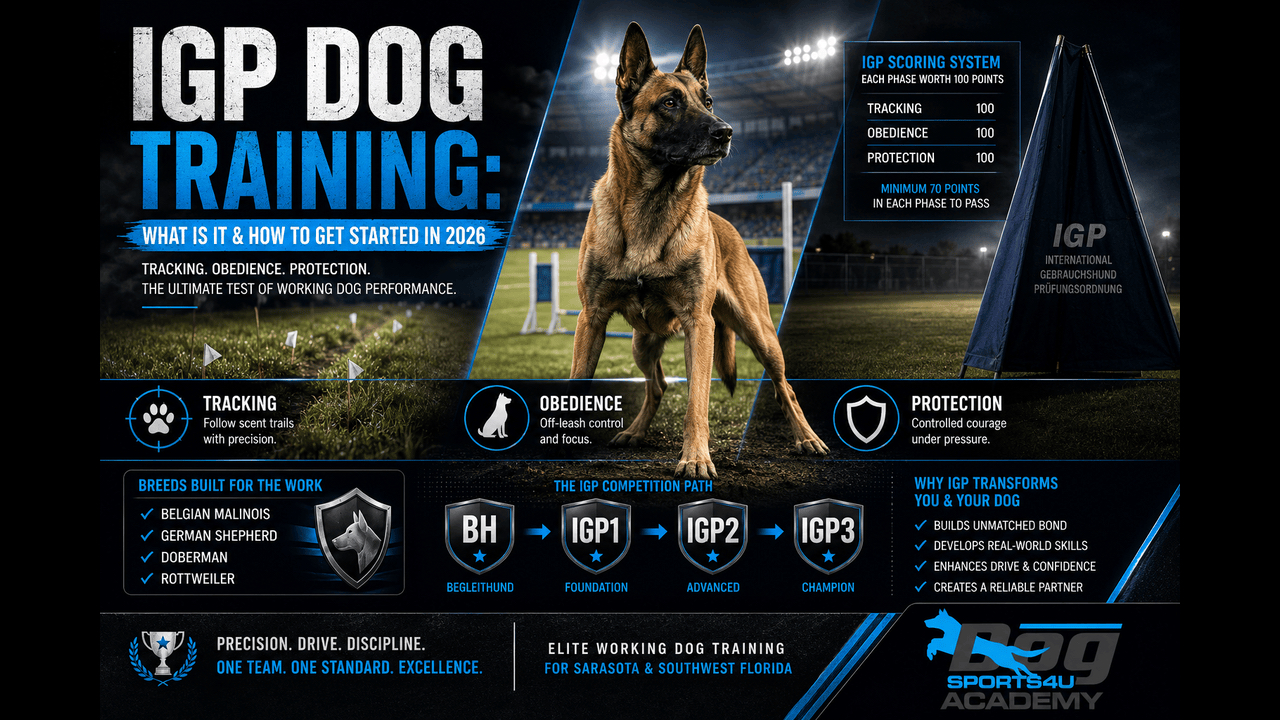
The sport has since expanded to include Belgian Malinois, Dobermans, Rottweilers, and a growing number of other working breeds. The sport is built around three phases, each testing a distinct dimension of the dog's capability.
Tracking requires the dog to follow a human scent trail laid out up to several hours earlier, locating small articles placed along the path. Obedience demands a complex sequence of exercises performed off-leash with enthusiasm and precision. The third phase evaluates the dog's nerve and control under pressure in a structured scenario with a decoy.
What the Scoring System Demands
Each phase is worth 100 points. Dogs must score a minimum of 70 in each to earn an IGP title. There are three title levels, IGP1 through IGP3, with difficulty increasing significantly at every stage.
The Breeds Built for This Work
What Drive Looks Like in Practice
Belgian Malinois have become the face of IGP and working dog sports globally, and the reasons are visible in every training session. Their prey drive, handler focus, work ethic, and physical athleticism combine to create a dog who is genuinely in his element when presented with demanding, structured tasks.
A well-bred Malinois lives for this sport in a way that few other breeds match. DogSports4U Academy has deep expertise with Belgian Malinois specifically, offering dedicated IGP programs for this breed across the Sarasota region.
German Shepherds remain deeply connected to IGP through the sport's origin as a breed evaluation test. A German Shepherd earning his IGP3 title is demonstrating everything the breed was developed to do.
Dobermans carry the nerve and handler attunement that make them competitive IGP dogs, particularly in the obedience phase, where their precision stands out clearly. Rottweilers bring physical substance and a deep-grounded stability that expresses itself powerfully throughout all three phases.
Before a Dog Can Enter an IGP Trial
The BH Is Where Everything Begins
Before competing at any IGP level, a dog must first pass the BH, or Begleithund. This is a companion dog temperament and obedience test that evaluates social stability around strangers, crowds, traffic, and other dogs.
A dog who shows inappropriate reactivity or fearfulness during the BH is dismissed from the evaluation. The minimum age for BH entry is fifteen months, and the minimum age for IGP1 entry is eighteen months.
These thresholds exist because the sport demands mental and physical maturity that younger dogs have not yet developed. Pushing a dog into trial preparation before that maturity is in place produces stress responses that often become entrenched behavioral patterns.
Why an Experienced Coach Changes the Outcome
Dog sports training at this level requires a mentor who understands how to develop drives appropriately and how to build obedience that holds under the pressure of a real trial environment. It also requires a coach who prepares the handler to read and direct their dog accurately across all three phases.
That combination is rare, and it is what separates competitive teams from those who train for years without meaningful progress.
The Relationship the Sport Builds
Why Competitors Rarely Return to Casual Ownership
Handlers who compete in IGP consistently describe the sport as transformational for their bond with their dog. The precision required during training forces a level of communication and mutual understanding that casual ownership rarely demands.
A dog who has been trained to IGP standards is a dog whose handler genuinely knows them. That depth of relationship is, for many competitors, ultimately what the sport is about.
DogSports4U Academy offers dedicated IGP preparation for working dog handlers across Sarasota and Southwest Florida, with programs led by coaches who have trained and competed at elite levels.
Don't miss a beat!
New tips, motivation, and classes delivered to your inbox.
We hate SPAM. We will never sell your information, for any reason.
